Two years ago, if a family shopping the western suburbs asked which town cost more, the answer took about half a second: Wellesley. It had for a decade. Needham was the value play, the town you settled for if Wellesley's price tag made you wince but you still wanted the schools and the commute.
That assumption is now wrong, and it flipped recently enough that most buyers touring both towns this fall haven't caught up to it. Needham's median single-family sale price has overtaken Wellesley's for the first time in at least five years. The gap isn't small, and the reason has almost nothing to do with which town is "better." It has to do with a demolition permit rule Wellesley passed in 2017 and the six extra months it bought Needham.
The Number That Flipped
In year-to-date 2026 figures reported this summer, Needham's median single-family sale price stood at roughly $2,359,500. Wellesley's, over the same year-to-date window, was about $1,897,500. That's not a rounding difference. Needham is running roughly $462,000 ahead of a town that has out-priced it every year since at least 2022.
Worth a quick flag here: if you pull up a portal like Redfin and see a lower Needham figure, that's not a contradiction. Redfin's blended median, which counts all home types including condos over the three months ending May 2026, landed closer to $1.7 million. Condos pull the number down. The single-family figure, which is the one that matters if you're comparing house to house against Wellesley, is the $2.36 million number, and it's the one that crossed over.
The climb that got Needham here is steep by any standard. The town's median single-family price moved from $1,455,000 in 2022, to $1,550,000 in 2024, to $1,975,000 in 2025, to this year's $2,359,500. That's a 62 percent increase in four years. The town's own assessors flagged the early stage of this in the FY2025 data, when a Department of Revenue-mandated review of 2022 and 2023 sales pushed the average single-family assessed value up 22.28 percent to $1,464,398.
Days on market tell the same story from a different angle. For four straight years, homes in Wellesley sold faster than homes in Needham. As of early 2026, that flipped too.
The Bylaw Nobody Was Watching in 2017
Here's the mechanism, and it starts with something as unglamorous as a demolition permit.
In 2017, Wellesley adopted a twelve-month demolition delay bylaw, which lets the town's Historical Commission hold up the teardown of a house it deems worth preserving for a full year before a builder can touch it. Needham's version of the same rule caps the delay at six months, and Needham's own Historical Commission has said publicly that six months hasn't been long enough to actually deter a teardown.
To a builder running a teardown-rebuild project, that difference is real money. A typical project runs 18 to 36 months from land acquisition through permits, construction, and listing. Carrying a property for an extra six months while a commission decides whether your target house is historically significant adds holding costs that cut straight into margin. Builders who were actively knocking down older homes in Wellesley in 2018 and 2019 started looking elsewhere. Needham, right next door, with the same school reputation and half the delay, was the obvious landing spot.
Those redirected projects didn't show up instantly. They took the better part of the build cycle to reach the market, which is why Needham's price climb didn't really register until 2022 through 2024, and why it's still accelerating now. The houses built by builders who left Wellesley in 2018 and 2019 are the ones sitting on the market today as barely-lived-in new construction.
That's also why over half of Needham's active inventory this year is less than a decade old, an unusual share for a MetroWest town this size. It isn't organic turnover. It's a wave of construction activity that started somewhere else and landed here.
There's a second piece that makes the effect stick rather than fade. Needham's own zoning bylaw restricts multifamily housing to a small share of buildable land and routes it through an expensive special permit process, according to the town's own housing coalition. That matters because it means the builder demand that arrived from Wellesley couldn't turn into more units. It could only turn into bigger, more expensive single-family homes replacing smaller ones on the same lots. The supply response to demand pressure was quality and price, not quantity. That's the difference between a bylaw shifting where construction happens and a bylaw shifting how much housing actually gets built, and Needham's zoning meant it got the former without the latter.
Where The Inventory Actually Sits
The town-level median is the least useful number for a buyer trying to decide between these two towns, because it hides how differently the two markets behave by price point. In an April 2026 snapshot of active listings, the split looked like this:
| Price Band | Needham Active Listings | Wellesley Active Listings |
|---|---|---|
| Under $1.5M | 15 | 14 |
| $1.5M – $2M | 14 | 4 |
| $3M – $5M | 10 | 16 |
| Above $5M | 1 | 11 |
The story isn't "Needham costs more now." The story is that Needham has pulled decisively ahead in the exact price band where most move-up families actually shop. A buyer with a budget in the $1.5 million to $2 million range had three and a half times more single-family inventory in Needham than in Wellesley in that April snapshot. That's the difference between a productive house-hunting weekend and a frustrating one.
Flip to the top of the market and the picture reverses completely. Above $5 million, Wellesley has eleven active listings to Needham's one. If your budget sits there, the median-price headline is irrelevant. Wellesley is still, for practical purposes, the only market in this comparison.
What This Means At Your Price Point
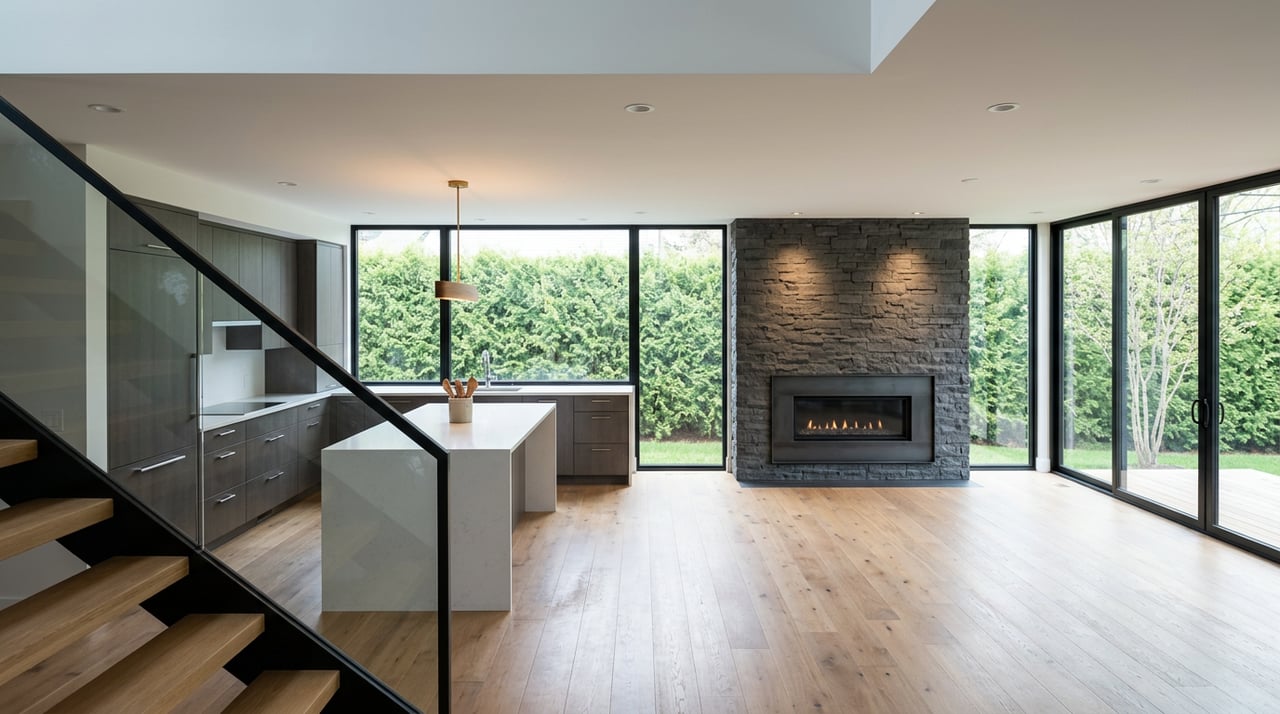
If your budget lands in that $1.5 million to $2 million band, Needham's advantage isn't just more choices, it's more finished choices. Because so much of the inventory is recent teardown-rebuild construction, you're more likely to be comparing move-in-ready homes with modern mechanicals and open floor plans against each other, rather than weighing a dated colonial against a full renovation project.
That has a practical downside worth knowing before you write an offer on an older Needham home with plans to renovate. New construction this year has been pricing around $544 per square foot and comes standard with the finishes buyers now expect, so a $200,000 kitchen renovation in a 1970s house rarely closes that gap. The next home a buyer tours is often a full rebuild on the same street.
Carrying costs deserve a line item too. Needham's residential tax rate for fiscal year 2026 is $10.83 per $1,000 of assessed value. The average single-family bill rose about 7.5 percent this cycle, from roughly $15,523 to $16,690, with that increase reflected on the bill due February 1, 2026. On a home near this year's $2.36 million median, that's a real annual number to weigh against a similarly priced Wellesley property, where assessment practices tend to track market value more tightly.
The Next Correction Is Already Permitted
None of this means Wellesley stays locked out of the mid-price band forever. The town became compliant with the state's MBTA Communities Law in 2024, which required it to zone for at least 1,392 multifamily units, with 90 percent of that capacity within a half mile of a transit station. That zoning exists on paper today.
The first project to actually use it entered the town's approval process this spring: a four-story, 28-unit condo conversion planned for a former multi-tenant office building at 16 Laurel Avenue in Wellesley Hills, steps from the commuter rail station, with a Zoning Board of Appeals hearing on site plan approval that opened in April 2026. It's a small building, and it's one data point, not a trend. But it's the first real test of whether Wellesley's zoning change produces actual units rather than just theoretical capacity, and if projects like it multiply, they represent exactly the kind of supply response Needham's own zoning has been structurally unable to produce.
That's a multi-year story, not a next-quarter one. For a buyer standing at the offer table this fall, the number that matters is the one in the table above, not the one on the horizon.
Where This Leaves You
The headline that Needham now costs more than Wellesley is true and almost useless on its own. What actually moves your search is where your budget lands relative to two very different inventory curves, curves shaped by a permitting decision nine years ago that had nothing to do with either town's schools or commute.
If you're weighing Needham against Wellesley, or trying to figure out what a specific budget actually buys in either town this fall, Allison Blank & Company can pull live inventory in your price band and walk you through what the comps are really saying before you write an offer.